

 Nadya Dudka
 Andrew Dyuzhov
OpenClaw and Claude Code do different jobs. OpenClaw is a free, MIT-licensed assistant that runs all day on your own machine and talks to you through about 30 chat apps, including WhatsApp, Telegram and Slack. Claude Code is Anthropic’s coding agent, from $20 a month, and it works inside a code repository. This OpenClaw vs Claude Code comparison goes side by side through models, cost, setup, automations, chat apps, memory, safety and coding.
OpenClaw vs Claude Code at a glance
| OpenClaw | Claude Code | Atomic Agent | |
|---|---|---|---|
| What it is | Self-hosted assistant with an always-on gateway | Anthropic’s agentic coding tool | Local-first agent: desktop app and terminal |
| Open source | Yes, MIT | No | Yes, MIT |
| Price | Free. You pay for the model, and a server if you want one | Pro $20/month, Max $100, Ultra $200, or pay per token | Free. $0 with a local model |
| Models | Dozens of providers, plus local models | Claude models only | Local models, plus OpenRouter, Anthropic, Gemini and more |
| Runs offline | Yes, with a local model | No | Yes, with a local model |
| Server to host | Yes, the gateway | No | No |
| Where you talk to it | About 30 chat apps, web dashboard, CLI | Terminal, VS Code, JetBrains, desktop app, web | Desktop app, terminal, Telegram, Discord |
| Best at | Automations, messaging, personal tasks | Code: repos, tests, git, CI | Local models with approvals, no server |
Sources: OpenClaw’s README and docs; Anthropic’s Claude Code docs and pricing page; Atomic Agent’s README. Checked November 19, 2026.
Models: OpenClaw vs Claude
This is the biggest difference, and most of the others follow from it.
OpenClaw works with dozens of providers: Anthropic, OpenAI, Gemini, OpenRouter, DeepSeek, Kimi and more. You can set a backup model for when one fails, or run fully local with Ollama, LM Studio, vLLM or llama.cpp. Claude Code runs only Claude models, with Opus 5.5 as the default on paid plans. Anthropic’s gateway docs say it “doesn’t support routing Claude Code to non-Claude models through any gateway.”
Atomic Agent sets up a local model for you on first run, with no API key, and connects to cloud models when you want more power.
What it means for you. With Claude Code you get one of the strongest coding models and never think about the choice. With OpenClaw or Atomic Agent you can use a cheap model for simple chores, a strong one for hard work and a local one for anything private. If your data can’t leave your machine, Claude Code is out.
Cost: what does each one really cost?
Claude Code has a fixed monthly price. OpenClaw’s cost depends on the model you connect and how much you use it.
Claude Code. The free Claude plan doesn’t include it. Pro is $20 a month ($17 billed yearly), Max is $100 and Ultra is $200, per Claude’s pricing page. Each plan has a weekly limit, and every plan except Ultra also has a 5-hour limit, so heavy days can hit a wall. You can also skip the plan and pay per token through the API. Across company deployments, Anthropic puts the average at $150 to $250 per developer a month. Our Claude Code pricing guide breaks down each plan.
OpenClaw. The software is free, with no paid tier or hosted version. You pay your model provider per token, or nothing with a local model. If you want it on 24/7, add a small server.
Here’s what the same amount of work costs on each setup. The example is 1 million input tokens and 100,000 output tokens, roughly a long day of agent work:
| Setup | Cost for that work | What changes the bill |
|---|---|---|
| Claude Code on Pro | $20 a month flat | Hitting the 5-hour or weekly limit |
| Any of them with Opus 5.5 by API ($4 / $20 per million tokens) | $6 | How much you use it |
| Any of them with Sonnet 5.5 by API ($2 / $10 per million tokens) | $3 | How much you use it |
| OpenClaw or Atomic Agent with a local model | $0 for the model | Your hardware and electricity |
What it means for you. If you code most days, a Claude plan is usually cheaper than paying per token. If you use an agent now and then, or mostly for light chores, a cheap or local model costs far less. One catch: OpenClaw can use your Claude plan by running your own installed Claude Code, but Anthropic’s support page says that usage draws from your plan limits, and OpenClaw’s docs recommend an API key for unattended automation.
Setup: a server you host vs an app you sign in to
Claude Code installs with one command, then you sign in with your Claude account. There’s no server to keep running.
OpenClaw also installs with one script and an onboarding wizard. But at its core is a gateway, a small service that has to stay on so the agent can answer messages and run jobs. It runs on a Mac, Linux, Windows or a small VPS, with 2 GB of RAM recommended.
Atomic Agent installs like Claude Code: download the desktop app for Mac, Windows or Linux, or the terminal version, and start. There’s no gateway to host.
What it means for you. Claude Code and Atomic Agent are ready in minutes. OpenClaw takes longer, and you own the machine it runs on, including updates and security. That’s the trade for an assistant that works while your laptop is closed.
Scheduled tasks vs automations
Both can now do work on a schedule, in different ways.
OpenClaw calls them automations: one-time reminders, repeating schedules, webhooks, Gmail triggers and watchers that wait for a condition. They run on your gateway, and results can go to any chat app you’ve connected.
Claude Code has three scheduling options: cloud tasks that run on Anthropic’s servers, desktop tasks that run on your machine, and /loop to repeat a prompt inside an open session. It can also start from GitHub or Slack.
What it means for you. Claude Code’s cloud tasks are the easiest way to run code work on a schedule, like a nightly test run, even with your computer off. OpenClaw is better for personal routines, like a morning brief sent to Telegram, as long as your gateway is on.
Texting it from your phone: chat apps vs channels
OpenClaw was built for this. It answers in about 30 chat apps, including WhatsApp, Telegram, Slack, Discord, iMessage, Signal and Microsoft Teams, per its channel docs.
Claude Code added channels for Telegram, Discord and iMessage, but they’re a research preview. You can also steer a running session from the Claude app with Remote Control.
Atomic Agent pairs with Telegram or Discord: you send tasks, tap approval buttons and get scheduled-task reports on your phone.
What it means for you. If you want to text your agent like a person in any app, OpenClaw has the most options. Claude Code’s phone features are for checking on and steering coding work.
Memory: Markdown files vs CLAUDE.md
OpenClaw keeps memory as plain Markdown files in its workspace. In its docs’ words, “there is no hidden state,” so you can open, edit or delete anything it remembers.
Claude Code reads CLAUDE.md files from your project for rules and context, and builds auto memory across sessions, stored on your machine.
What it means for you. Both are files you can read and edit. OpenClaw’s memory is about you: your preferences, people and routines. Claude Code’s is about your project: how to build it, test it and what to avoid.
Safety: open by default vs locked by default
Claude Code is ahead out of the box.
It starts terminal and VS Code sessions in auto mode, where a classifier model approves or blocks each action, and manual mode asks before most edits and commands. An optional sandbox limits shell commands, and Anthropic holds SOC 2 Type 2 and ISO 27001 certifications.
OpenClaw’s sandboxing is off by default, so tools run directly on your machine until you set it up. Its security page lists over 700 published fixes in 2026. In February, Koi Security found hundreds of malicious skills on ClawHub, its public skill registry, and OpenClaw now scans skills with VirusTotal. A Trail of Bits audit in September found no critical issues.
Atomic Agent asks before shell commands, file writes and other risky actions from the first run.
What it means for you. Claude Code and Atomic Agent check with you before risky actions by default. OpenClaw needs setup first: turn on sandboxing, keep the gateway private, install only skills you trust and run openclaw security audit. Our guide Is OpenClaw safe? walks through each step.
Claude Code vs OpenClaw for coding
Claude Code wins, and OpenClaw agrees. Its own FAQ says to use Claude Code or Codex “for the fastest direct coding loop inside a repo.”
Claude Code understands your codebase, runs your tests, works with git and fits into CI through GitHub Actions and GitLab. It adds skills, hooks, MCP servers, plugins and subagents on top. OpenClaw can write and run code with a strong model, but it isn’t built around a repository.
What it means for you. If you write code every day, use Claude Code for it. If you want both, use Claude Code for the repo and OpenClaw for everything around it, with its own API key so the two don’t share one plan’s limits.
A third option: Atomic Agent
Atomic Agent is a local-first, open-source agent that takes the parts people like in each tool: the local models and always-on tasks of OpenClaw, and the download-and-go setup of Claude Code. It’s free under the MIT license, with a desktop app for Mac, Windows and Linux, plus a terminal version.
- Local models out of the box, for $0. It runs on a local model with no API bill and no key, so your prompts and files stay on your computer. Cloud models work too, with your own key for OpenRouter, Anthropic, Gemini and others.
- No server to run. Like Claude Code, it’s an app you download and open.
- Asks before risky actions. Shell commands and file writes wait for your OK.
- Scheduled tasks and overnight runs. Cron schedules, webhooks and reminders, plus
atomic-agent overnightfor one long task capped by a dollar budget and a time limit. - Fusion. One model plans and a pool of workers runs the parts in parallel. You can mix a local and a cloud model in the same task.
- Long sessions on small hardware. Our TurboQuant build of llama.cpp compresses the model’s memory cache up to 6.4x, so local models handle long work in far less RAM.
- Works with your Claude Code setup. It installs Claude Code plugin packages and imports your Claude Code skills, memory, MCP servers and chats.
- Control it from your phone. Pair Telegram or Discord to send tasks, tap approvals and get reports.
Coming from OpenClaw or Claude Code? The first run offers to import your data without touching the originals, or run atomic-agent import openclaw or atomic-agent import claude-code later. Add --dry-run to preview what moves before anything is written:
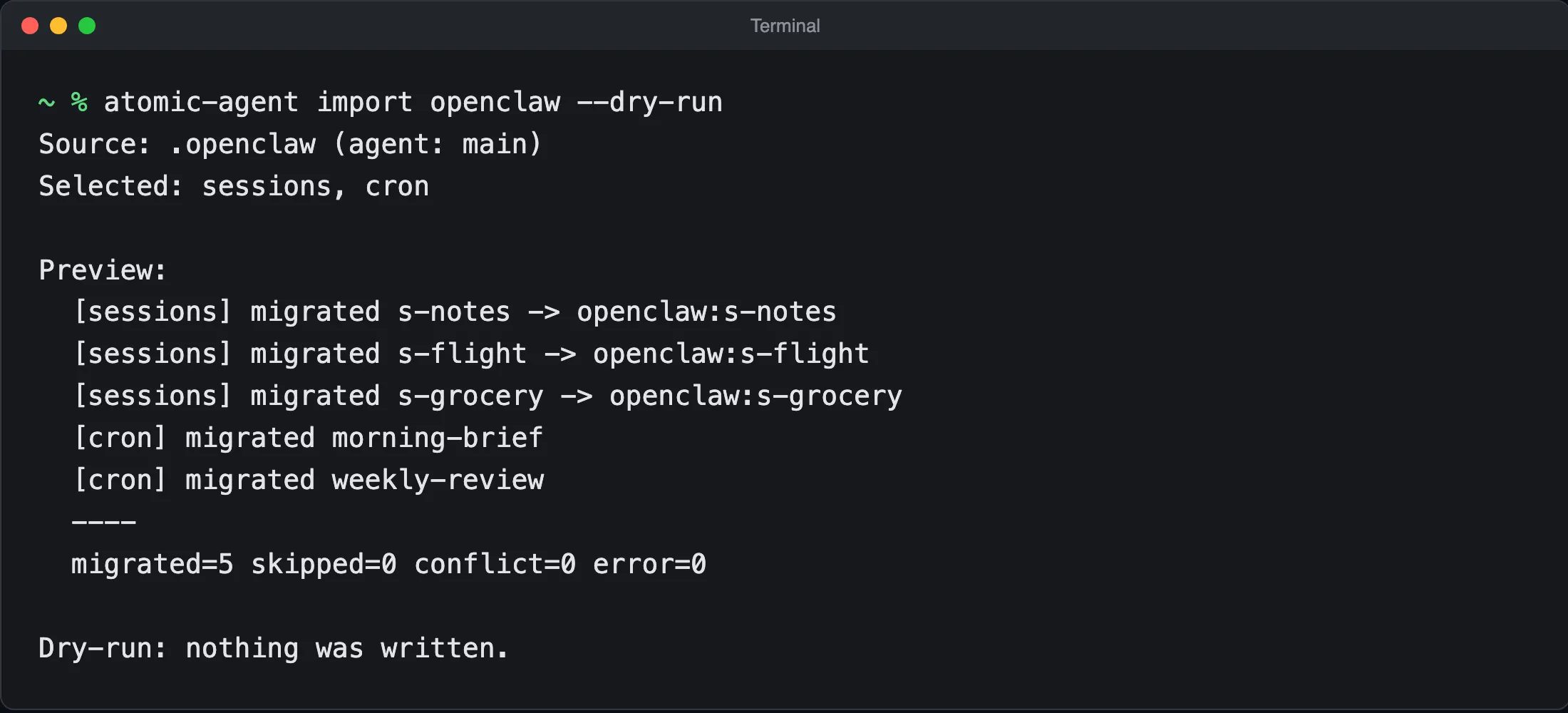
Atomic Agent previewing an import of sample OpenClaw data: 3 chats and 2 scheduled jobs. A dry run writes nothing.
For hard coding work, connect a cloud model: a local model on a laptop is slower than Claude Code with Opus 5.5. Download Atomic Agent for free, or install the terminal version with one command:
curl -fsSL https://atomicagent.io/install | shThe source is on GitHub.
Frequently asked questions
Which one should you pick?
For code, use Claude Code. For an assistant you can text, running all day on any model, use OpenClaw, and set up its sandbox before you give it real accounts. For a local-first, open-source agent with no server, try Atomic Agent. If you’re leaving OpenClaw, our OpenClaw alternatives page compares eight options, and for coding tools see our open-source Claude Code alternatives. For Anthropic’s agent for office work, read Claude Cowork vs OpenClaw.
Checked on November 19, 2026, against OpenClaw v2026.11.5, Atomic Agent v0.8.0 and Anthropic’s Claude Code docs and pricing page. Facts come from each tool’s docs, pricing pages, blog, security page and GitHub, with the ClawHub malware count from Koi Security.